

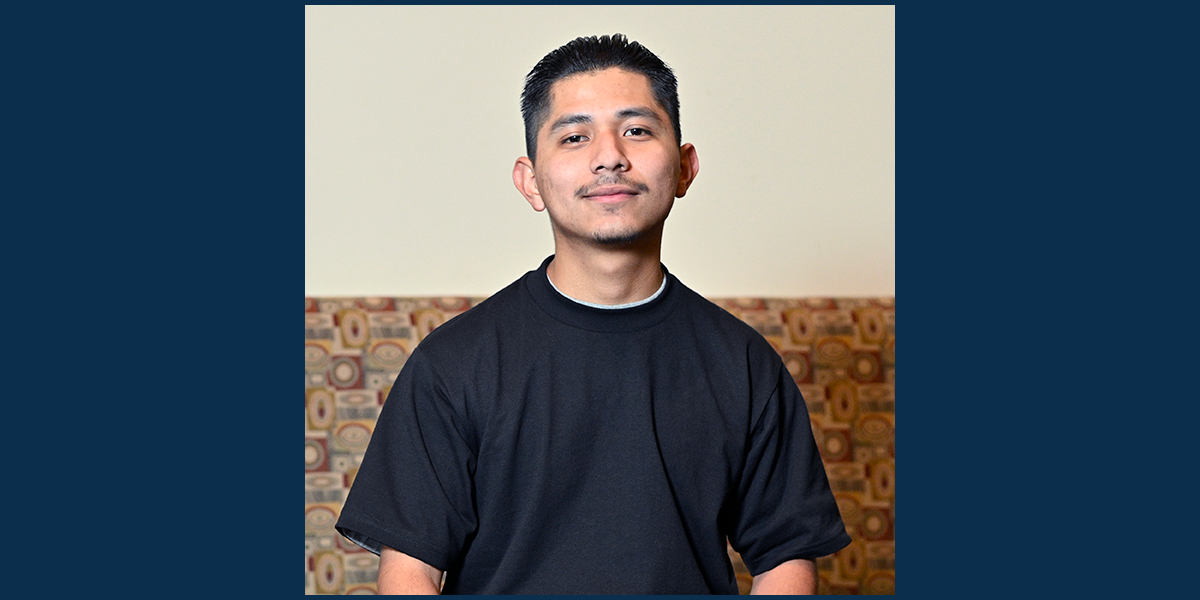
Mental Health Talent Pipeline Spotlight: Meet Apolinar Vega
4 min read. Apolinar Vega, our newest Mental Health Talent Pipeline scholarship recipient, reflects on his work with at-risk youth and his goals for the future.
In fall 2025, Apolinar Vega began the master’s program in Counseling Psychology at USF Santa Rosa, supported by one of three scholarships awarded in 2025 through the Healthcare Foundation’s Mental Health Talent Pipeline. Born and raised in Sonoma County, Apolinar is the first in his family to pursue higher education—a milestone made even more meaningful given the significant challenges he faced growing up in a community impacted by underemployment, gang violence, substance use, and high crime rates.
With the guidance of dedicated mentors, counselors, and therapists, Apolinar was able to navigate those early obstacles and channel his experiences into a deep commitment to serving others. Today, he is pursuing a career in Marriage and Family Therapy (MFT) with the goal of giving back to the northern Sonoma County community that shaped him.
In the following conversation, Apolinar reflects on his journey, the impact of the USF program, his work with at-risk youth, and the mentors who inspired him to pursue this path.
How has growing up in northern Sonoma County shaped you?
It’s given me a deep personal understanding of the communities here. Growing up, I witnessed both the strength of ordinary people and the challenges they can face, particularly in terms of emotional wellbeing and support. Being from Sonoma County has built a long-term connection that has shaped my desire to serve the community.
What drew you to your career path in counseling psychology?
My interest in counseling psychology developed, first of all, through my own experience—learning to recognize things like past trauma and behavioral patterns, and healing from them through therapy and self-reflection. Something valuable I learned along the way is that this healing doesn’t erase the past but it gives you a better understanding of yourself. It gave me more accountability and helped me develop healthier ways of coping with my past trauma and behavior patterns. I believe it was that realization that made me pursue this profession in counseling psychology. It has allowed me to support myself in my own personal growth but it also allows me to support others.
“I really enjoy working with at-risk youth. I was once labeled that as well. Seeing how far I’ve come since then inspires me to model that potential for younger people in situations like those I experienced.”
Apolinar Vega
When did you decide on the professional track?
At 17, I was still unsure where I wanted to go after high school but eventually I enrolled in the junior college and decided to major in sociology. I continued that major through the completion of my undergrad at Sonoma State. It was fascinating. I see, also, that it was a natural transition to what I’m doing now. While sociology is relevant, in terms of approach I realized that I love the one-on-one. That’s where psychology emerged for me as the path forward.
How do you find the graduate program at USF so far?
My experience at USF has been amazing. And it has included a lot of self-healing as well. Two semesters into the program now, I’m really intrigued and engaged. It motivates me to be out there in the community, where there’s a lot of need and a lot of people suffering in silence.
Has it given you a new perspective on the need in the community?
I had some idea of the need when I started, but as I have gone further in my studies, and started working outside of the program as well, it has really clicked for me, how much of a need there is—the need for bilingual counselors, therapists, and services more generally.
What is the importance of the bilingual and bicultural component?
I can point to my own case. When I first started therapy it was really tough for me, because I couldn’t relate to anyone. But that changed completely once I connected to someone who was bilingual. Now I felt that my therapist had an understanding of my background, my lived experiences. That allowed me to open up in a way I couldn’t before. It was from that point, for me, that the progress started.
What outside work are you doing, or have you done that relates to your career path?
Currently, I’m working with people with disabilities, which relates somewhat. At an earlier stage in my education, I worked with youth in continuation schools, through services offered here in Santa Rosa. I really enjoyed working with at-risk youth. I was once labeled that as well. Seeing how far I’ve come since then inspires me to model that potential for younger people in situations like those I experienced—and hopefully to motivate them in whatever they dream of doing, whatever career or calling. To let them know it’s possible.
Would you like to work with youth again after graduating?
For sure. Working with youth-at-risk, potentially youth in the juvenile halls, or after they are released and on probation, or in continuation schools—I believe there is a lot of work to be done. I graduated from a continuation school myself. At a personal level I saw what was lacking, and it was a lot. But I know when people come in and treat them with respect, and meet them where they’re at, it’s a game changer. I think that’s what allowed me to connect with them. They would often tell me, “Some of these adults treat us like we’re less, or just don’t understand us.” I remember when I first heard that, I didn’t quite process it completely. I wasn’t yet in the USF program and I didn’t have the benefit of that training. But it stuck with me. Now, knowing a bit more in terms of theories and approaches, what they were talking about makes perfect sense.
Do you have any role models who helped you in a similar way?
Most definitely. Once I transitioned back to school, I had a number of people who supported me, assisted me and guided me. But when I look back, the person who I consider the most influential figure along my journey is my best friend. He has since passed away, but although he’s no longer here physically, he has impacted me profoundly. He always reminded me of my potential and encouraged me to live with a purpose. His loss was deep, at the time I didn’t even quite understand it. But I believe nothing is ever in vain, because it has deepened my understanding of the points of connection. It has inspired me to be present for people, to give hope and support to others. These are things I learned from him. I might have been very young then, this was about ten years ago, but I keep his memory in that way—to keep pushing no matter what challenges come. It’s a way of thanking him, for letting me know change is possible. And ten years later, we’re still on our journey.
Is there anything else you would like to add?
When I think of northern Sonoma County, I think of the beautiful landscape and its calmness. At the same time, though it’s a beautiful place, the other layer I’ve noticed more and more is how many individuals are quietly struggling. I’m grateful that the environment here in Northern California, including now the program at USF, has taught me to find ways to approach people with humility and empathy; really, to just be curious—to meet people where they are at and together create that safe space that they’ve been seeking. I believe that is what has helped me and allowed me to thrive so far. I’m excited about the future, about learning more, developing more skills, and growing as a person, so that I can best support and serve our communities.

Related News + Stories

Invest in Our Community
Your support is vital to our collective vision of eliminating health inequities in northern Sonoma County.
Donate